Space beer due to the different behavior of the main components barley and yeast in microgravity.
Updated: 2025-09-07
Created: 2018-11-01
Status
Hops have been grown in space and yeast has been space-flown. Research into yeast growth and barley germination in microgravity environment. TRL 9 would be when drinkable (bottled) beer would be made in space. Starbase Brewing & Jaguar Space mission in 2025.
Applications
- Unique novelty product to capture the interest of new population segments.
- Research into yeast cells is applicable to human cells.
Why & Solution
Yeast and humans are about 70 percent similar in genetics, making these microbes ideal for studying how human cells adapt to space. Spaceflown yeast strains showed DNA and RNA damage and a variety of changes suggesting that microgravity affects core cellular processes. These findings can direct future investigations of environmental modifications to minimize these effects during long spaceflights and to identify drugs to help control harmful effects in humans. The experiments also demonstrate that full genome screening can be done during spaceflight using small-suitcase-sized hardware, significant for future studies in space and extreme environments on Earth. Addresses risks to biological integrity and life-based support systems for long-term occupation in space. Results from this study allow researchers to gain a global perspective to the genes that play a role in survival, in regards to microgravity conditions, and will allow for a more thorough understanding of the effects of microgravity on a model organism. The expectation is that what is observed in yeast is likely to have a comparable effect in mammalian cells. This is supported by the observation that regulatory mechanisms are largely conserved between yeast and mammalian cells. 2
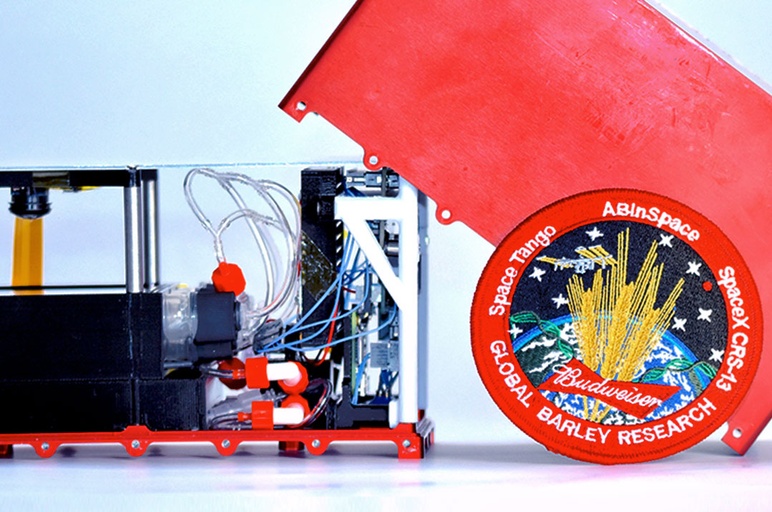
Budweiser’s innovation team selected barley, one of its core ingredients, to be the focus of the first two experiments in space. Malting barley is a process that results in the high-quality malt used in the Budweiser enjoyed today and the research on the International Space Station will unveil how the barley seeds react in a unique microgravity environment. One of the experiments will focus on barley seed exposure with the second testing barley germination. Not only will the research offer insights on steps to creating beer on the Red Planet, but it could also provide valuable information on the production of barley and the larger agricultural community here on earth. 1
- Bottles of beer have been launched to over 30 km in altitude and returned safely on balloons. BridgePort performed such a suborbital mission in 2018.
- Lanikai Brewing Company in Hawaii released “Interplanetary Ale” in 2019 from yeast harvested at the edges of the Earth’s atmosphere. The pilots took along one of Steve’s petri dishes on a regular research flight and opened in up for half an hour in the cockpit to see what they could collect.
- In late 2021, Samuel Adams craft beer company out of Boston announced that it's launching Space Craft, a beer brewed from 66 pounds of hops that traveled more than 300 miles above Earth on the Inspiration4 first-ever all-civilian space mission. A four-pack costs $22.33 as an homage to the Inspiration4 crew's historic spaceflight, which lasted two days, 23 hours, three minutes.
- Yuri's space beer in collaboration with HOSTmi, Hopstronautix and BarthHaas will be named "Galactic Brews".
Companies


Budweiser (Anheuser-Busch) page at Factories in Space
Announced its intention to be the first beer on Mars.
Budweiser is upholding its commitment to be the first beer on Mars by confirming upcoming experiments on the International Space Station with plans to send and study barley – one of its key ingredients – into space.
Hopstronautix page at Factories in Space
- To keep the beer affordable, only a small fraction of the ingredients needs to be in space as the expected result can be already experienced with a small amount.
- Therefore, we launch hops, as they are the most iconic ingredient in beer. Initially, the hops will be launched onboard a sounding rocket to space where they will experience the regime of space for a few minutes, before returning back to Earth using a parachute.
- This small portion of hops will then be incorporated into space themed beer at European and American craft breweries. During a trial experiment, performed in the United States, with Celestial Beerworks of Dallas, Texas, the beer release party was combined with a presentation by the rocket launch provider (EXOS Aerospace) on the mission, the technology behind it, and to overall increase awareness and excitement for space.
- Celestial was immediately sold out of their batch of space beer, and the public provided strong positive feedback in their enjoyment of not only the beer, but the outreach program that came with it.
- The plan is to release an Indian Pale Ale and Imperial Stout (to mimic the black expanse of space). Each batch will be brewed using a portion of hops from a dedicated mission which is indicated on the bottle. The beer is then sold and distributed through Germany, Europe and the United States.

Jaguar Space page at Factories in Space
Advancing your science & business through access to space and expert advice.
This is the first beer fermentation study in space where yeast and wort are mixed in microgravity, enabling us to study the gravity-driven process of “top fermentation” and what implications this may have for future bioprocesses in space.
Suds and Soil: Two Brewing Experiments to Launch to ISS, 2025-07-31.
- Starbase Brewing founder Nate Argroves and Jaguar Space founder Luis Zea teamed up on two ISS experiments with big implications for future space explorers looking to unwind over a cold one.
- The experiments are expected to fly on the NASA Crew-11 launch set for Thursday afternoon.
- Optimizing Agriculture in Simulated Interplanetary Soils (OASIS): It will attempt to grow barley aboard the ISS in simulated Martian regolith, adding spent grain from brewing to support crop growth. Texas A&M Agrilife, which has been working with the brewery on Earth-based research for two years, will also join this experiment.
- MicroBrew-1: It will send tubes to space where wort (or unfermented beer) and freeze-dried yeast are stored in separate chambers. An astronaut will turn a crank to combine them and set off the process of top fermentation, which typically relies on gravity. Zea will then study how the lack of gravity affects fermentation when the tubes are returned to Earth.
- Argroves helped shape the overall vision for the experiments, and provided brewing advice. He also contributed funding, noting that “a large percentage” of Starbase Brewing’s proceeds are invested into research.
PRESS RELEASE: SEEDS FROM 11 COUNTRIES GOING TO ISS FOR RESEARCH
- We’re excited to share our latest press release announcing the launch of the “Emerging Space Nation’s Space for Agriculture & Agriculture or Space” payload, a globally diverse collection of seeds contributed by research institutions, space agencies, and scientific organizations across 11 countries and 5 continents. The payload is scheduled to launch aboard NASA’s Crew-11 mission on July 31, 2025, from Kennedy Space Center.
- This mission brings together species with deep agricultural, nutritional, and cultural significance, including maize from Guatemala, pomegranate from Armenia, cotton from Egypt, wheat from Pakistan, and coastal mangrove species from the Maldives (among many others), to investigate climate resilience and seed preservation in microgravity. It is a powerful symbol of international collaboration in science and a meaningful step toward inclusive space exploration.
MicroBrew-1 is now brewing aboard the ISS!
A Starbase Brewing and Jaguar Space payload, this cutting-edge experiment studies top fermentation in microgravity — paving the way for advances in biomanufacturing, sustainable food systems, and life support beyond Earth.
PRESS RELEASE: EXPERIMENT TOWARDS TURNING MARTIAN REGOLITH INTO SOIL LAUNCHING TO ISS THIS THURSDAY


Sapporo page at Factories in Space
“SAPPORO Space Barley” Beer Is Launched Onto The Market For The First Time In The World In Limited Quantities For Charity
- April 2006 - Haruna Nijo malting barley developed by Sapporo Breweries through collaborative research with Okayama University and the Russian Academy of Sciences was kept aboard the Zvezda Service Module, a component of the International Space Station (ISS), for five months (first-generation “space barley”).
- April 2007 - Seeded the first-generation “space barley”.
- November 2007 - Harvested the second-generation “space barley”; seeded the second-generation “space barley”.
- May 2008 - Harvested the third-generation “space barley”.
- October 2008 - Trial brewing of the world’s first beer made from the third-generation “space barley”.
- November 2008 - Seeded the third-generation “space barley”.
- January 2009 - Tasting events held at breweries nationwide for beer made from the third-generation “space barley”.
- May 2009 - Harvested the fourth-generation “space barley”.
- August 2009 - Hop seeds from Furano, Hokkaido launched into space.
- September 2009 Tasting events held at five breweries nationwide for barley tea made from “space barley”.
- November 2009 - Seeded the fourth-generation “space barley”.
- December 2009 - Applications accepted to buy SAPPORO Space Barley-the beer brewed from the fourth-generation “space barley”.


Starbase Brewing page at Factories in Space
Starbase Brewing is a Texas-based craft beer brand aiming to be the first brewery on Mars.
Suds and Soil: Two Brewing Experiments to Launch to ISS, 2025-07-31.
- Starbase Brewing founder Nate Argroves and Jaguar Space founder Luis Zea teamed up on two ISS experiments with big implications for future space explorers looking to unwind over a cold one.
- The experiments are expected to fly on the NASA Crew-11 launch set for Thursday afternoon.
- Optimizing Agriculture in Simulated Interplanetary Soils (OASIS): It will attempt to grow barley aboard the ISS in simulated Martian regolith, adding spent grain from brewing to support crop growth. Texas A&M Agrilife, which has been working with the brewery on Earth-based research for two years, will also join this experiment.
- MicroBrew-1: It will send tubes to space where wort (or unfermented beer) and freeze-dried yeast are stored in separate chambers. An astronaut will turn a crank to combine them and set off the process of top fermentation, which typically relies on gravity. Zea will then study how the lack of gravity affects fermentation when the tubes are returned to Earth.
- Argroves helped shape the overall vision for the experiments, and provided brewing advice. He also contributed funding, noting that “a large percentage” of Starbase Brewing’s proceeds are invested into research.
Revenue Estimation
Cost Estimation
Could start with only yeast and/or barley itself, which is a small percentage of mass in a 1 liter of drink.
Earthly Solution Risk
Taste might be imitated eventually, but uniqueness remains.